
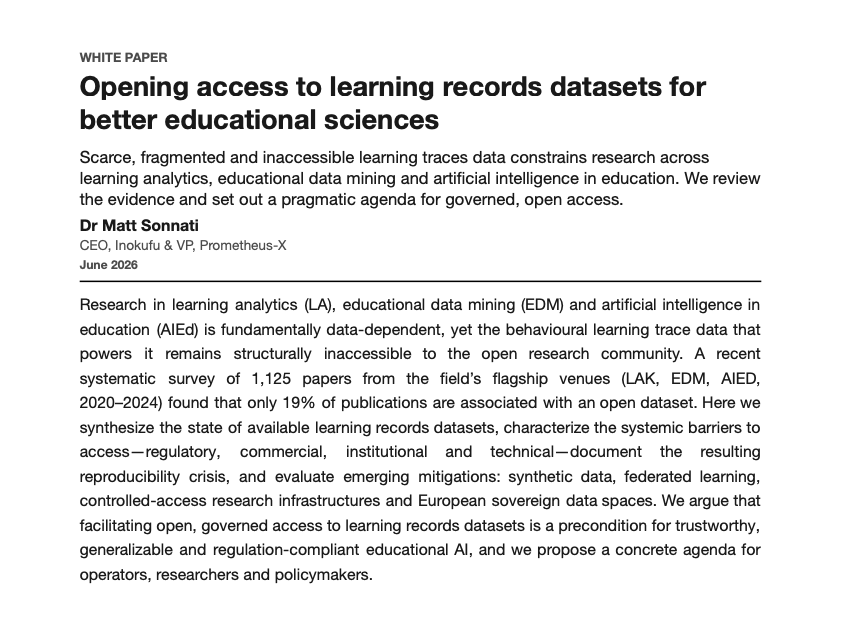
A review of 1,125 papers published between 2020 and 2024 in learning analytics (LA), educational data mining (EDM) and artificial intelligence in education (AIEd), delivers a stark finding: only 19% of publications share the underlying data. That number matters to L&D leaders, HR directors, CIOs and LMS operators as much as it does to researchers. It gives a real measure of what the AI systems currently sold on the corporate learning, higher education and public training markets are actually built on.
A learning record is a time-stamped trace of a learner’s interaction with content: a quiz answer, a module read, time spent on a resource. These traces are produced by learning platforms (LMS) in standards such as xAPI, cmi5, SCORM or Caliper, and stored in a technical repository called a Learning Record Store (LRS). A dataset here is a structured collection of such traces, with its documentation. Nearly every AI system applied to education, from the model that predicts dropout to the one that recommends the next resource, is trained on such datasets.
The problem is not a shortage of data. Every LMS or educational application generates thousands, sometimes millions, of traces. The problem is that the datasets on which educational AI research actually rests are limited, ageing and geographically skewed. A significant share of the models featured in specialised publications is trained on US learner data from 2009 to 2015, mostly in K-12 mathematics, and evaluated on the same. The direct implication for a European L&D leader or CIO considering an AI-powered training system: the scientific evidence a vendor cites rarely describes the actual context of use, particularly for adult learners in continuing professional education.
The actual landscape of available datasets
A reference systematic review identifies 172 unique datasets used across 204 publications, of which 143 had never been catalogued in prior surveys, a signal of chronic dispersion. Three access modes coexist: 75.6% of datasets are directly downloadable, 14.0% require a free account, 10.5% are described as available on request. The last category is the most problematic. Of 35 datasets nominally available on request, only half were actually provided within 30 days. Reasons cited by data holders for declining to share are, in order: lack of time (29%), data no longer available (28%), legal or privacy concerns (23%).
Research concentrates on a small set of canonical resources. Twenty datasets are used at least three times, the single most cited reaches 12 citations in the analysed corpus. Familiar names dominate: OULAD (Open University UK), ASSISTments (K-12 mathematics, US), KDD Cup, Statics 2011, xAPI-Edu-Data. The overwhelming majority describe a US school or university context.
Four structural limits
Scale. Public learning analytics datasets are small by deep-learning standards, typically a few thousand learners and tens of thousands of interactions. Knowledge-tracing models such as DKT, SAKT and AKT, which learn a learner’s progression dynamics, suffer particularly. Performance gains reported between architectures often reflect overfitting to benchmarks rather than better cognitive modelling.
Geographic bias. European coverage is marginal, Southern Hemisphere coverage almost non-existent. A model trained on US curricula in English does not transfer reliably to a Dutch vocational programme, a German apprenticeship scheme or an Italian corporate academy. This is not an academic inconvenience, it is an external-validity problem that becomes a business problem when the system moves to production.
Domain bias. Public datasets cover schools and universities, chiefly STEM and language learning. Continuing professional development, corporate learning, adult learners, cross-platform pathways and trainer activity are almost absent. Applied R&D teams building solutions for European corporate academies work on proxies far removed from their actual use cases.
Benchmark obsolescence. OULAD covers course presentations only up to 2014, ASSISTments spans the 2009 to 2015 school years. Learner digital behaviour has since shifted (mobile, micro-learning, interactive video, gamification), pedagogical formats have evolved (post-Covid, adaptive, blended), and modern collection standards such as xAPI and cmi5 were not yet adopted at the time of capture. The distribution shift between training and production data is mechanical.
Four barriers to access
| Barrier | What it produces in practice | What lifts it |
|---|---|---|
| Regulatory (GDPR, FERPA) | Traces are personal data. Even anonymised, they can allow re-identification through cross-linking. Sharing is particularly heavy where minors are involved. | Data protection impact assessment (DPIA), robust anonymisation protocol, explicit legal basis, Article 28 processor agreement. The specific legal framing depends on the organisation and belongs to its DPO and legal function. |
| Commercial | Large platforms hold massive volumes but have no economic incentive to publish, seeing release as a gift to competitors. Academic labs work on small public datasets, the internal R&D teams of large operators work on private ones. | Sovereign data spaces where sharing happens under controlled conditions, with usage traceability and value returned to the data producer. |
| Institutional | 46% of researchers cite data organisation as an obstacle, 37% cite licensing uncertainty, 60% feel insufficiently credited when they share, 75% have never received institutional help in publishing their data. | Systematic documentation (dataset card, provenance, bias), recognition and citation of the producer, an intermediary capable of preparing the deposit. |
| Technical | Format heterogeneity across SCORM 1.2, SCORM 2004, xAPI, cmi5, Caliper, proprietary logs, and the absence of standardised domain-specific xAPI profiles. Makes datasets hard to combine. URLs are unstable: of 13 URLs listed in a 2020 survey, four had become invalid by 2026. | Interoperability parsers (Prometheus-X), permanent archival repositories (Zenodo, Harvard Dataverse), shared xAPI profiles. |
A reproducibility crisis
Low data availability translates directly into low reproducibility within the field itself. At LAK 2021 and 2022, only 5% of papers made their raw data available and none could be reproduced within the time allowed. EDM 2021 and 2022: 15% of papers used or released a public dataset, with results partially matched on 6% of them. AIED 2021 and 2022: 13% had openly available data, 7% were potentially reproducible, no reproduction attempt fully succeeded. These figures place the discipline behind comparable computational fields. The MORF framework, run jointly by Michigan, Pennsylvania and Duke on MOOC data, showed that predictive models trained on one MOOC dataset generally fail to transfer to others. Concentration on a few heavily cited datasets creates a community-level overfitting risk.
Four mitigation paths, with their limits
Synthetic data. A synthetic dataset is an artificial dataset produced by a model that has learned the statistical structure of a real one, without exposing individual records. The SynEdu-HEDL project produced 20,000 synthetic learner records with 85 features. Models trained on them reach performance within 1 to 5% of models trained on real data, and a transfer scenario using only 10% real data improved performance by 24.4%. Limits are real: modelling extreme values remains difficult, biases from the source data are inherited, and validating a synthetic dataset is a complex exercise. Synthetic data reduces risk, it does not remove it.
Federated learning. An approach where the model is trained locally at each institution and only the learned parameters are shared, never the data. Recent experimental work shows accuracy comparable to centralised training and stronger resilience to adversarial attacks. In education, deployment remains rare, held back by infrastructure cost and LMS fragmentation.
Controlled-access research infrastructures. The principle: the researcher never obtains raw data, they send code into an environment where the data lives and receive aggregated results back. MORF, PSLC DataShop at Carnegie Mellon and LearnSphere operate on this logic. These are little known outside Anglo-American academic circles and almost non-existent for European professional-training data.
European data spaces. A data space is a federated infrastructure where multiple organisations share data under common governance rules, with access traceability and regulatory compliance. Prometheus-X and Gaia-X contribute to the Data Space for Education and Skills (DASES), aimed precisely at scaling this for learning data.
Six sharing levels, to escape the false dilemma
The standard objection to any sharing request is binary: keep everything to protect the organisation, or publish everything and put it at risk. This dilemma does not exist in practice. Six sharing levels coexist and can be combined:
Anonymised open data, published with no access restriction
Synthetic data derived from a real dataset
Access on request under agreement, with review of the research project
Controlled access in a secure environment, no data leaves it
Federated computation or learning, only parameters travel
Sharing via a sovereign data space, with traceability and value return
The right level depends on regulatory context, sensitivity of the traces, the population concerned and the maturity of the organisation. No choice is universal, none removes the need for an impact assessment and an anonymisation protocol.
What we do
Inokufu orchestrates the creation of datasets for operators that hold learning records: trace collection and mapping across SCORM, xAPI, cmi5 and Caliper, anonymisation and pseudonymisation, dataset documentation, qualification of the appropriate sharing mode, and matching with researchers. Prometheus-X is an association that governs an open source stack of components for building European data spaces. This clear separation of roles prevents any abuse arising from combining data-processing and data-governance responsibilities within a single entity.
You hold learning records
Your xAPI or SCORM traces are a dormant asset for as long as they remain undocumented, ungoverned and inaccessible through a suitable channel. They can become a competitive edge: a dataset validated by research is a strong signal to corporate buyers, to compliance readiness under the EU AI Act (Regulation (EU) 2024/1689) and to audit preparation. The right sharing level is not necessarily open publication. If you would like to explore how to make value from your data, get in touch.
You need data to publish
The shortage of European, corporate-learning, cross-platform datasets and traces mapped to skills frameworks such as ESCO is well documented. These are high-impact publication niches, precisely because they are under-covered. Access to recent, documented data goes through contractual frameworks that also protect the data holder: research agreement, controlled access, secure environment, federated learning. If you would like to explore access to such data, get in touch.
Read the full white paper
If you want to go deeper, our white paper is available on Zenodo. It takes about thirty minutes to read.
Read the white paper on Zenodo
Cite this document
Sonnati, M. (2026). Opening access to learning records datasets for better educational sciences. Zenodo. https://doi.org/10.5281/zenodo.21904089
